
Rena Moue
Kanai Labratory, Department of Physics and Astronomy, Faculty of science and technology, Tokyo university of science
Born on May 23, 1999.
From Saitama, Japan.
Email: r.moue.0523@outlook.jp
Field of Research
Surface physics / Spintronics
Profile
CV
-
Ph.D. student (Apr. 2024 - Mar. 2027)
Kanai Labratory, Department of Physics and Astronomy, Faculty of science and technology, Tokyo university of science- JSPS Research Fellow for Young Scientists (DC1) (Apr. 2024 - Mar. 2027)
-
Graduate student (Apr. 2022 - Mar. 2024)
Kanai Labratory, Department of Physics and Astronomy, Faculty of Science and Technology, Tokyo university of science- Awarded the Award of the Dean's List of Faculty of Science and Technology in 2023. (Mar. 2024)
-
Undergraduate student (Apr. 2018 - Mar. 2022)
Kanai Labratory, Department of Physics, Faculty of Science, Tokyo university of science
Research
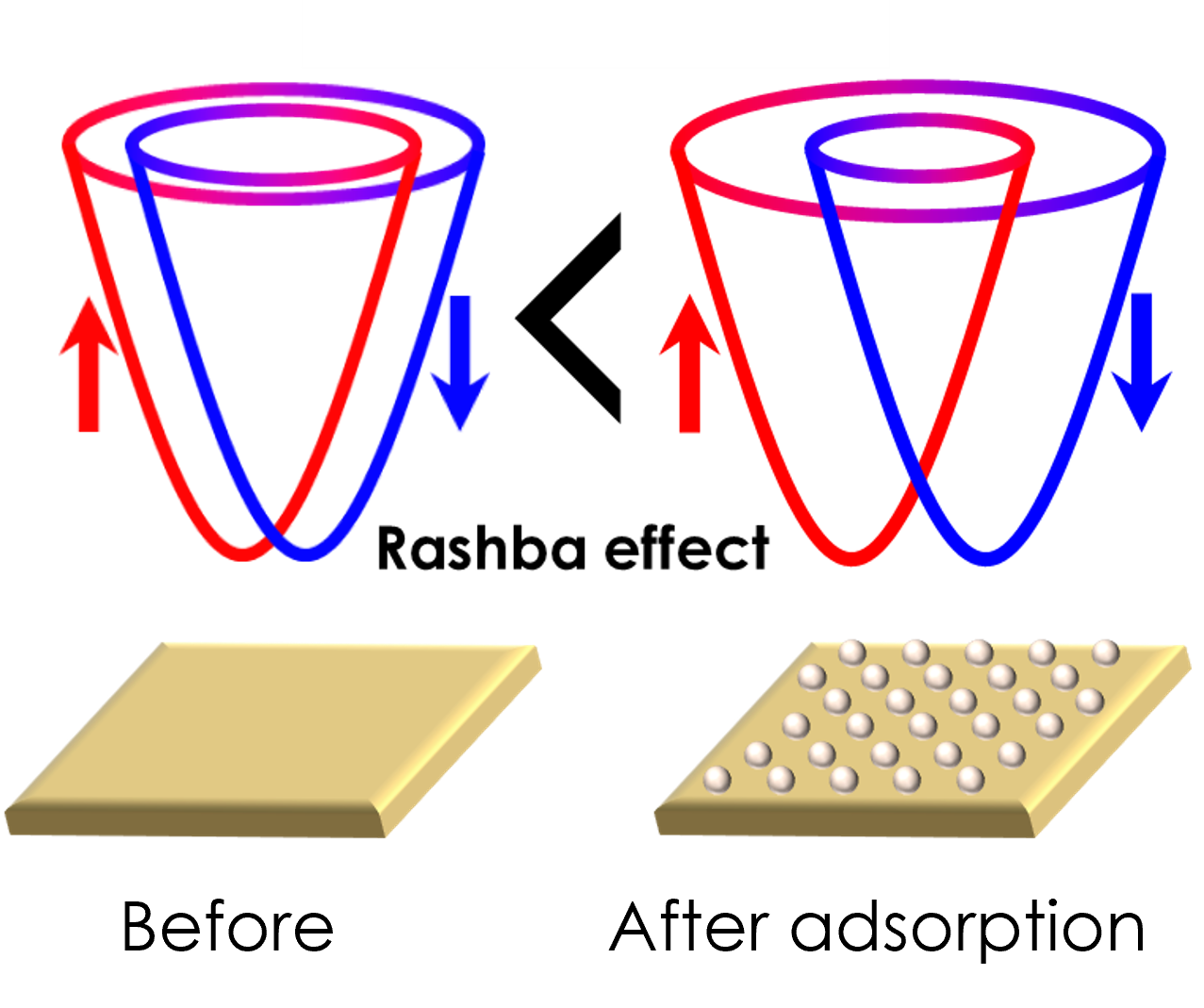
Electrons have spin in addition to charge. The flow of polarised electron spin that occurs in solids and on solid surfaces is called spin current. Spin currents ideally do not generate Joule heat and can therefore be used for information processing and communication with reduced energy loss. It is therefore considered to contribute significantly to the development of the field of spintronics technology. In addition, it is attracting attention as a revolutionary development in semiconductor miniaturisation technology, which has reached its limits in recent years. However, spin currents have the challenge that they relax before they can be transmitted as a signal. One solution is to use the Rashba effect to obtain a spin current large enough to withstand the relaxation effect.
The 'Rashba effect' is an effect in which spin splitting occurs in the surface electronic state due to spin-orbit interactions (SOI) caused by spatial inversion symmetry breaking at the surface/interface of a solid. In particular, the Rashba effect is well known to appear on the surface states of noble metals. In addition, it has been observed that the Rashba effect is enhanced by the adsorption of different atoms and molecules on the noble metal surface. If this mechanism can be elucidated and the Rashba effect can be artificially increased, spin currents can be efficiently generated and controlled. It has been reported that the Rashba effect can be significantly enhanced by selecting heavy atoms with large SOI as adsorbates. An increase in the Rashba effect has also been reported in systems where noble gases and some organic molecules without a large SOI are adsorbed on the noble metal surface. On the other hand, the mechanism of the change in the Rashba effect when organic molecules are adsorbed on the noble metal surface has hardly been investigated.
The aim of this study is to investigate the changes in the Rashba effect when organic molecules adsorbed on a noble metal surface interact with each other to form long-range ordered structures, and to elucidate the mechanisms involved.
Achievement
Published
-
"Enhanced Rashba Splitting of Au(111) Surface States with Hydrogen-Bonded Melamine-Based Organic Framework"
R. Moue*, Y. Kokubo, K. Mukai, H. Mizushima, Y. Fukushima, K. Kawaguchi, T. Kondo, A. Harasawa, J. Yoshinobu, K. Mase, S. Shin, and K. Kanai*
Adbanced Materials Interfaces, 9, 2201102 (2022). -
"Topological Surface State of Bi2Se3 Modified by Physisorption of n-Alkane"
R. Moue*, H. Yamazaki, T. Kitazawa, K. Yaji, H. Yaguchi, K. Kuroda, T. Kondo, A. Harasawa, T. Iwahashi, Y. Ouchi, S. Shin, and K. Kanai
ChemNanoMat, 9, e202200538 (2023). -
"Near-ultraviolet organic light emitting diodes using melem
H. Minamide, T. Yamazaki, H. Kiuchi, R. Moue, Y. Shonoda, and K. Kanai*
Chemical Physics Letters, 815, 140367 (2023).
Conference Presentation
-
"Observation of melamine/Au(111)-Honeycomb structure and the modified surface electronic state on Au(111)."
R. Moue, Y. Kokubo, K. Kawaguchi, Y. Fukushima, A. Harasawa, K. Mukai, S. Shin, T. Kondo, J. Yoshinobu, K. Kanai
The 77th JPS Annual Meeting, 17a-GE11-1, Online, Mar. 2022 (Oral). -
"Modification in Au(111) surface electronic structure by hydrogen-bonded organic framework"
R. Moue, Y. Kokubo, H. Yamazaki, K. Mukai, F. Ozaki, Y. Fukushima, K. Kawaguchi, R. Mori, T. Kondo, A. Harasawa, J. Yoshinobu, S. Shin, K. Kanai
The 70th JSAP Spring Meeting, 15a-B508-7, TOkyo, Mar. 2023 (Oral). -
"Modification in Au(111) surface electronic structure by organic nano-porous framework"
R. Moue, H. Yamazaki, Y. Fukushima, K. Kawaguchi, R. Mori, T. Kondo, A. Harasawa, S. Shin, K. Kanai
The 84th JSAP Autumn Meeting, 20a-D903-2, Kumamoto, Sep. 2023 (Oral by Invited).
Award
- The 54th (Spring 2023) JSAP Lecture Encouragement Award, May 2023.
- the Award of the Dean's List of Faculty of Science and Technology in 2023., Mar. 2024.